
Developer Identity Management is not access provisioning or IAM.
It is the practice of attributing software risk to identity—understanding whether code was introduced by a human developer, a developer using AI, or an autonomous AI agent, and preserving that context across the SDLC.
Within modern development environments, developers act as custodians of source code, dependencies, CI/CD workflows, and AI-assisted tooling. Their actions directly influence security outcomes. Without identity-aware visibility, organizations are left with vulnerabilities that have no clear owner, no context, and no reliable path to prevention.
Developer Identity Management is operationalized through Developer Security Posture Management (DevSPM), which links scan results and security findings to developer identity and actions across the SDLC.
This enables organizations to:
Attribute vulnerabilities and policy violations to specific developers or AI agents
Preserve historical context for how risk entered the codebase
Enforce accountability without slowing development
Support investigation, remediation, and compliance with identity-aware evidence
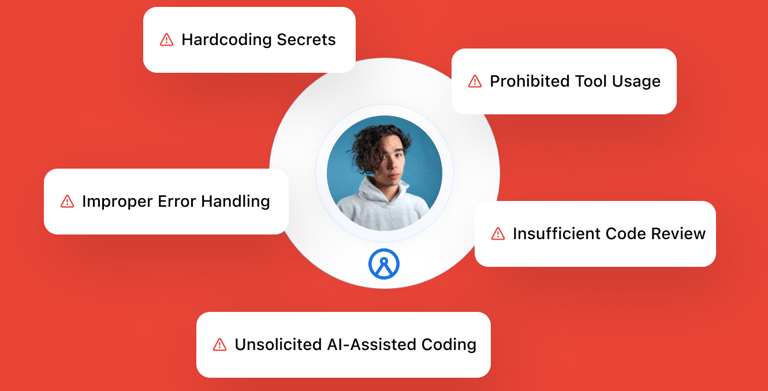
Developer risk does not emerge in isolation. It is introduced through actions taken by identifiable actors across tools, repositories, and workflows.
Without developer identity attribution, organizations face recurring exposure from:
Insider Threats
Compromised credentials or misuse of access can lead to unauthorized code changes, data exposure, or deliberate sabotage—often without clear attribution.
AI-Assisted Development
When AI tools generate or modify code, organizations must understand who invoked the AI, where AI-generated code entered the SDLC, and how it correlates with downstream vulnerabilities.
Shadow IT and Unapproved Tools
Developers frequently introduce tools, plugins, or services outside approved inventories. Without identity-linked telemetry, these actions remain invisible.
Leaked Secrets and Sensitive Data
API keys, credentials, or tokens embedded in source code are rarely attributable after the fact—making remediation slow and incomplete.
Developer Identity Management ensures that risk is never detached from the actor who introduced it.
Security incidents consistently show that identity blind spots—not just code flaws—enable breaches:
Identity Mismanagement and Insider Risks, Uber Breach (2022): Compromised developer credentials allowed a hacker to access Uber’s internal systems, exposing sensitive user and driver data. This incident emphasized the need for robust identity and access controls in development environments.
AI-Driven Code Vulnerabilities, GitHub Copilot Flaw (2024): Researchers found that GitHub’s Copilot AI tool occasionally suggested insecure code, such as functions prone to SQL injection or XSS, especially when paired with vulnerable codebases.
These incidents highlight why developer identity must be treated as a first-class security signal.
Archipelo enables Developer Identity Management by creating a historical record of coding events across the SDLC tied to developer identity and actions—human and AI.
This identity-aware telemetry forms the foundation of Developer Security Posture Management, strengthening existing ASPM and CNAPP stacks with attribution and accountability they cannot provide on their own.
Key Capabilities:
Developer Vulnerability Attribution
Trace scan results and vulnerabilities to the developers and AI agents who introduced them.Automated Developer & CI/CD Tool Governance
Scan developer and CI/CD tools to verify tool inventory and mitigate shadow IT risks.AI Code Usage & Risk Monitor
Monitor AI code tool usage to ensure secure and responsible software development.Developer Security Posture
Generate insights into security risks introduced by developer actions across individuals and teams.
Together, these capabilities ensure that every risk has an identity, every incident has context, and every remediation has a clear owner.
Ignoring developer identity creates persistent exposure across the SDLC:
Vulnerabilities without ownership
Incidents without root cause clarity
Compliance evidence without attribution
Repeated risks across teams and workflows
Developer Identity Management—enabled through Developer Security Posture Management—makes developers observable, accountable, and governable without disrupting velocity.
Archipelo strengthens existing ASPM and CNAPP stacks with developer-level observability and telemetry—providing the identity context required to secure modern software development.
Contact us to learn how Archipelo strengthens your existing ASPM and CNAPP stack with Developer Security Posture Management.